A SHORT BITSY GAME · 2020
Zero to
Something
A small cat.
A simple objective:
find the way home.
PLAY BEFORE READING THE STORY
Take the first step.
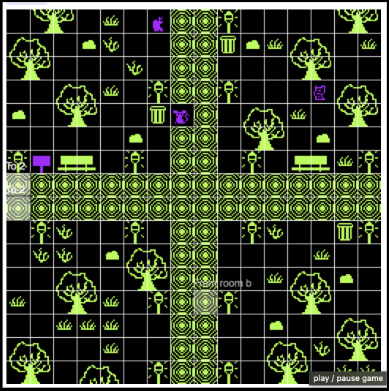
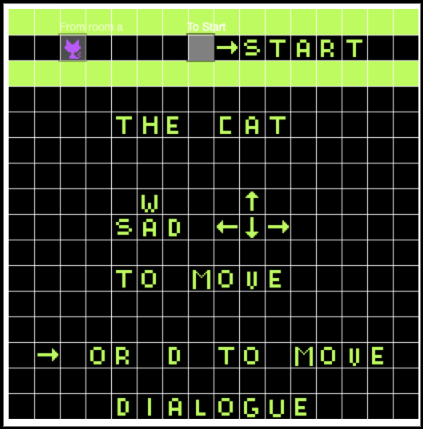
Move with the directional keys. Walk into characters and objects to discover dialogue. The mechanics leave room for the search itself.
Play the original on itch.io ↗Opens the existing game page in a new tab. The original game is externally hosted; the screens below remain available here.
DESIGNING WITH CONSTRAINTS
A few pixels can
carry a great deal.
Tile artwork in Bitsy HD Hack.
A deliberately restricted room palette.
Simple animation that stays legible.
Movement as storytelling
I built rooms square by square from tiles, sprites, items and the player avatar. With limited visual detail, paths and dialogue had to carry the experience.
The restricted palette distinguishes the world from things the player can approach. Moving into an object becomes a moment of reading; crossing a room becomes part of the story’s rhythm.
Keeping the action small
The player’s job is to continue searching. Adding more mechanics would have pulled attention away from the cat’s point of view.
THE DESIGN BEHIND THE SEARCH
Some things are better
discovered in play.
Read the narrative design notes — contains story spoilers
The player understands first
The cat believes it is lost. The player gradually recognizes that it has been abandoned. That gap between understanding and hope gives an ordinary search a different emotional weight.
The idea grew from conversations about quarantine pet adoption and the responsibilities that continue afterward. I wanted the player to encounter the situation from the animal’s perspective.
A portrait made of tiles
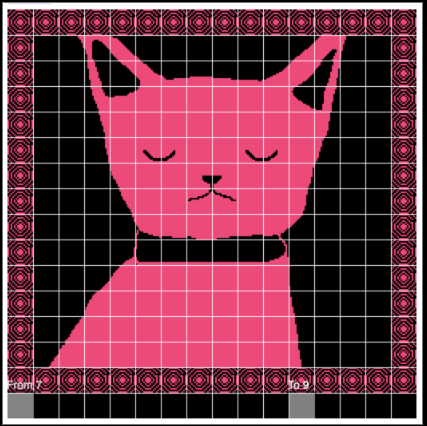
The large cat portrait was assembled from individual tiles. Invisible items along the bottom trigger its internal monologue, slowing the player down without adding another mechanic.
The project notes describe emotional responses from players. They are personal observations, not a measured audience study.
Original game-development archive
Overview
Zero to Something is a short narrative game about a cat that wakes up alone in a park and tries to find its way home.
The cat believes it is lost. As the player moves through the world, talks to other characters and interacts with objects, it gradually becomes clear that the cat was not accidentally separated from its owner. It was abandoned.
I made the game in 2020 using Bitsy HD Hack, a browser-based pixel game tool with strict visual and technical limitations.
Despite how small and simple the game is, people responded to it emotionally. The story often made players feel genuinely sad, which made me realize that an interactive experience did not need complex graphics or mechanics to communicate something difficult.
Context
The idea came from conversations I was having with friends about people adopting animals during quarantine.
There was a lot of attention around pets becoming companions during isolation, but I was also thinking about what might happen later, once people returned to their normal routines or realized they were not prepared for the responsibility.
I wanted to address abandonment without turning the project into an article, infographic or direct educational message.
A game allowed the player to experience the situation from the animal’s perspective. Instead of being told that abandonment is harmful, the player slowly understands what has happened while guiding the cat through the world.
That delayed realization became the emotional center of the project.
Concept
The player controls a cat that thinks it has simply become lost.
The objective appears to be straightforward: move through the park, collect clues, speak to other characters and find the way home.
As the game continues, the cat’s dialogue and the details in the environment begin to reveal a different situation.
The cat does not fully understand that it has been abandoned. It continues to interpret what happened through trust, confusion and hope.
I wanted the sadness to come from that gap between what the player understands and what the cat still believes.
The game does not depend on a dramatic reveal or graphic imagery. Its emotional effect comes from small pieces of dialogue and from spending time inside the cat’s limited understanding of the situation.
Why Bitsy
Bitsy is an extremely limited game-making tool.
The standard version uses an 8 by 8 pixel grid, while Bitsy HD Hack expands that to 16 by 16. Rooms use only three colors, objects and characters have extremely simple animation and most interaction happens through movement and dialogue.
I was interested in what those limitations could make possible.
Because I could not rely on detailed imagery, cinematic animation or complicated mechanics, I had to focus on:
- pacing
- dialogue
- room structure
- color
- repetition
- environmental clues
The restrictions forced me to think more carefully about what information the player actually needed and how a few pixels or lines of dialogue could carry emotional meaning.
Process
I began by planning the different rooms the player would move through.
Bitsy uses four main kinds of elements:
- tiles for the environment
- sprites for characters and interactive objects
- an avatar controlled by the player
- items that can be collected
I designed each room square by square using these limited components.
The main environments included paths, trees, benches, objects and characters the cat could approach.
The visual system used a black background with two brighter colors. One color helped establish the world while the other made interactive elements easier to identify.
Each room could use a different palette, which allowed the mood to shift as the story progressed.
Pixel Art and Animation
Every object, character and tile had to be designed within the small pixel grid.
The cat avatar used a two-frame animation to create a basic walking movement.
Other objects and sprites could also be animated, but only across two frames. This meant movement had to remain simple and readable.
One of the most time-consuming scenes was a large portrait of the cat. Each square of the image had to be created and placed as an individual tile so that the separate pieces formed one coherent image.
The player moves along the bottom of this room to trigger the cat’s internal monologue.
I created the sequence using invisible items that acted only as dialogue triggers. They were essentially black squares containing text rather than visible collectible objects.
That became one of the most important moments in the game because it slowed the interaction down and allowed the player to focus entirely on the cat’s thoughts.
Narrative and Dialogue
Dialogue carried most of the emotional weight of the project.
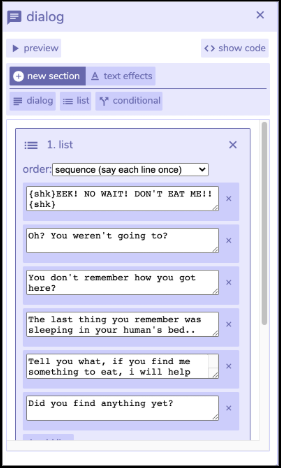
Characters, objects and invisible triggers could each contain text. Bitsy also supported conditional dialogue, allowing certain lines to change depending on what the player had already found or done.
I used this to make the story unfold gradually rather than explain everything at once.
The cat’s language stays simple because it does not fully understand its situation.
It remembers sleeping in its human’s bed and assumes it only needs to find the route back. That innocence makes the story more painful because the player begins to understand the truth before the character does.
Text effects were also used to give certain lines more emphasis and emotional rhythm.
Interaction
The player moves through the game using directional keys.
Interaction happens by:
- walking into characters
- examining objects
- collecting items
- moving between rooms
- triggering dialogue
The mechanics are deliberately simple so that they do not distract from the story.
The player’s main role is to continue searching.
That search creates the emotional tension. The player may already suspect that there is no home to return to, but the cat continues moving forward as though finding the correct path will solve everything.
Emotional Response
One of the strongest outcomes of the project was that it made people feel sad.
The visual style is extremely minimal and the game is short, but players still became emotionally attached to the cat and affected by what they gradually discovered.
I think that happened because the game does not begin by announcing itself as a story about abandonment.
The player enters through curiosity and a familiar goal. They want to help a small character get home.
Once the meaning becomes clear, that original objective feels different. The act of continuing to search becomes painful because the player understands something the cat does not.
That response showed me how strongly interaction can affect empathy. The player is not only watching the cat’s situation. They are responsible for moving it through the search.
Outcome
The final outcome was a complete short browser game published through itch.io.
It could be played without downloading anything, which made it easy to share and allowed the project to reach people outside the class where it was made.
The game successfully used a restricted set of tools to tell a complete story through rooms, dialogue, movement and pixel art.
Conceptually, it remains one of my stronger early projects because the form and subject support each other so closely.
The limited visual language makes the cat feel small and vulnerable, while the simple movement keeps the player focused on searching and reading.
Reflection
Looking back, I think the project worked because it did not try to do too much.
The mechanic is simple, the visual system is limited and the story follows one emotional idea from beginning to end.
At the time, I was still learning how interactive storytelling worked, but the project taught me that complexity is not the same as emotional depth.
A technically simple game can still create a strong response if the pacing, point of view and interaction are carefully chosen.
The most important decision was telling the story through the cat’s perspective.
If the game had explained everything directly, it would have felt more like a warning about irresponsible pet adoption. By allowing the cat to remain hopeful and confused, the player has to reach the conclusion themselves.
This project became an early foundation for my interest in using interaction to create emotional experiences rather than only functional ones.
It also showed me that I am interested in stories where the interface gives the viewer incomplete information and asks them to piece together what is really happening.
If I developed it further now, I would preserve its simplicity.
I might refine the dialogue, sound and pacing, but I would not turn it into a much larger or more mechanically complicated game. Its emotional effect comes from how small, quiet and direct it is.
The form is small on purpose.
Complexity is not
the same as emotional depth.
Made with Bitsy HD Hack by Fred Bednarski, based on Bitsy by Adam Le Doux.